



Inhaltsübersicht
- 1 Efficient strategies for modern, data-supported maintenance
- 2 Maintenance terminology
- 3 Definition of condition-based maintenance
- 4 Difference between reactive and condition-based maintenance
- 5 Importance of condition-based maintenance for the manufacturing industry
- 6 Digital instructions as part of the networked service ecosystem of Transaction-Network
- 7 How does condition-based maintenance work?
- 8 Excursus: Standards and legal requirements
- 9 Different types of maintenance
- 10 Predictive maintenance vs. condition-based maintenance
- 11 Advantages of condition-based maintenance
- 12 The challenges of condition-based maintenance
- 13 Examples and measures
- 14 Digital monitoring, servicing, maintenance, documentation – maintenance in the modern industrial world
- 15 Maintenance and servicing strategy for your systems digitally supported: the “instructor” helps!
- 16 FAQ on condition-based maintenance
Efficient strategies for modern, data-supported maintenance
In industrial production, efficient maintenance strategies are crucial to productivity, quality and competitiveness. While fixed maintenance intervals used to be the standard, modern companies are increasingly relying on flexible, data-based procedures.
Condition-based maintenance (CBM) is one of the central concepts here. It uses measured values, sensors and digital systems to precisely monitor the current condition of a system. On this basis, maintenance work is only carried out when it is actually necessary.
In this way, CBM not only helps to reduce downtimes, but also to sustainably extend the service life of your machines and devices. In combination with digital solutions such as tepcon’s “instructor”, this creates intelligent maintenance management that makes operations more efficient, transparent and safe.
Let’s take a closer look at this concept in the following article: For example, how does it differ from the concept of “predictive maintenance”, what can its use bring to your business and your team, and what problems might arise?

Maintenance terminology
The world of maintenance is complex – numerous terms describe different strategies, approaches and types of maintenance.
Here is a quick overview of the most important maintenance strategies, which offer very different solutions:
- Condition-based maintenance: Maintenance is only carried out when the condition of a system requires it.
- Condition-based maintenance: An overarching term that includes CBM, both terms are sometimes used interchangeably. It is based on the monitoring and analysis of physical variables such as vibrations, temperature or performance.
- Predictive maintenance: Goes beyond CBM by using algorithms and AI-powered models to predict future problems and failures.
- Corrective or fault-based maintenance: Only reacts when a fault or failure has already occurred.
- Prescriptive maintenance: uses AI systems not only to make predictions but also to make recommendations for action.
- Reliability Centered Maintenance: Focuses on the long-term reliability of systems and processes.
These different maintenance models show: Modern maintenance is no longer a reactive process; the right choice is a strategic success factor.
Are you in a hurry? Click here to go directly to our product, the tepcon instructor!
Definition of condition-based maintenance
Condition-based maintenance CBM is a sub-form of preventive maintenance and aims to carry out maintenance measures exactly when they are necessary. The current condition of machines or systems is monitored continuously or at intervals.
Typical measured variables used to monitor machines and systems include temperature, vibrations, pressure, flow or energy consumption. As soon as defined threshold values are exceeded, maintenance is initiated.
CBM therefore uses data to make informed decisions – a clear advance over time-based maintenance, which intervenes at fixed intervals regardless of actual wear.
The principle: If sensors report a decrease in performance or unusual values, an intervention is planned before a failure occurs. This minimizes downtimes and increases the availability of production systems.
CBM increases efficiency and reduces costs across the entire operation. Your teams can tackle maintenance jobs as soon as the condition requires it, avoiding unnecessary downtime or over-maintenance.
Difference between reactive and condition-based maintenance
Whereas with reactive maintenance, action is only taken when a malfunction or failure occurs, CBM acts proactively.
Reactive means that a machine breaks down and repairs only begin afterwards. This leads to longer downtimes, increased maintenance costs and potential consequential damage.
Condition-based, on the other hand: Continuous monitoring and analysis of sensors and data enables the optimum maintenance time to be identified. Interventions are targeted before problems arise.
The result: lower costs, predictable processes and greater reliability – albeit at a higher cost for sensors and data analysis.
Importance of condition-based maintenance for the manufacturing industry
Digitalization is fundamentally changing maintenance. Today’s industrial plants are complex, networked and highly automated – one error or unplanned downtime can cost millions.
This is where the value of condition-based maintenance becomes apparent: it enables the efficient use of resources, extends the service life of critical components and reduces the risk of unplanned downtime.
In conjunction with modern maintenance strategies, IoT technologies and software solutions such as the “instructor”, condition monitoring can be seamlessly integrated into existing processes. This gives companies a real-time view of their systems – a decisive advantage in the age of Industry 4.0.
Digital instructions as part of the networked service ecosystem of Transaction-Network
Another important building block for efficient, digital maintenance processes is the close cooperation with our partner Transaction-Network.
Transaction-Network is a cross-industry, industrial service ecosystem in real time – manufacturer-neutral and cloud-based. It connects operators, machine manufacturers and material suppliers on a single platform and ensures that machine downtimes are avoided by identifying critical situations at an early stage and automatically integrating all relevant partners.
In combination with tepcon’s “instructor”, this creates a strong synergy potential: digital work and test instructions become part of a networked overall system that makes maintenance measures even faster, safer and more transparent.
How does condition-based maintenance work?
The basic principle of the CBM strategy is simple: maintenance is only carried out when indicators point to an imminent reduction in performance.
The inspection is carried out using measuring systems, sensors and data acquisition devices that monitor parameters such as vibrations, temperature or pressure in real time.
The recorded status data is analyzed continuously or at defined intervals. If the system detects deviations, maintenance work is triggered automatically.
In contrast to preventive maintenance, which is based on fixed intervals, CBM reduces maintenance costs because interventions are only carried out when necessary. In addition to the reduced maintenance effort, this also lowers costs and increases the availability of the systems. If you would like to know how we optimize both condition-based and predictive maintenance and servicing with our software, simply ask us directly!
Book your personal demo and experience the benefits directly!
Excursus: Standards and legal requirements
International standards play an important role in the implementation of condition-based maintenance. DIN EN 13306, which sets out the basic terms and definitions of maintenance, is particularly relevant.
It describes the different types of maintenance, including preventive, corrective and condition-based procedures, thus creating a common language for operators, manufacturers and service providers.
In many industries, further standards, safety guidelines and documentation requirements must also be observed – the “instructor” offers an efficient way of documenting processes in an audit-proof manner.
Different types of maintenance
- Reactive maintenance – intervention after the failure has occurred
- Preventive maintenance – maintenance at fixed intervals
- Condition-based maintenance (CBM) – maintenance depending on the condition of the system
- Predictive maintenance (PdM) – data-driven forecast of future failures
- Prescriptive maintenance – AI-supported recommendations for action
Predictive maintenance vs. condition-based maintenance
Although both strategies are based on the collection of status data, there are clear differences:
With condition-based maintenance, the current status of your systems is monitored in order to detect problems immediately. Predictive maintenance goes one step further: it combines sensor data, historical information and AI algorithms to accurately predict the optimal time for the next maintenance.
In a system with a predictive approach, for example, cavitation in a pump system can be detected at an early stage – based on vibrations, temperature and ambient data.
The advantage: even more precise planning, fewer failures, higher uptime.
Both approaches complement each other and often form the basis of a sustainable maintenance strategy.

Advantages of condition-based maintenance
Condition-based maintenance offers a number of advantages – especially for manufacturing companies that require high plant availability:
- Minimized downtimes and lower costs of unplanned downtimes
- Optimized maintenance intervals through data-based planning
- Increased reliability and safety for employees
- Reduction of unnecessary maintenance work and spare parts stocks
- Extended service life of machines and devices
- Plannable processes and lower personnel costs
With CBM, teams not only increase efficiency, but also create transparency throughout the entire operation.
The challenges of condition-based maintenance
Despite all the advantages, CBM also entails requirements and problems:
The installation of sensors and monitoring devices can result in high initial costs. Analyzing large amounts of data requires trained personnel and powerful software.
Technical challenges also play a role: some sensors cannot withstand harsh operating environments, older systems are difficult to retrofit, and even wear and tear cannot always be clearly measured.
CBM is therefore not a sure-fire success – it requires a clear approach, modern technologies and well-trained teams.
This is where the “instructor” helps to digitally standardize work processes, maintenance measures and test steps.
What can this look like for you? Start your test run for the “instructor” right away !
Examples and measures
Numerous methods are available for monitoring systems:
From simple visual inspections by technicians to complex IoT sensors that measure vibrations, temperature or power consumption in real time.
Examples are
- Vibration analysis for rotating machines
- Thermography for detecting overheating
- Oil analysis for transmissions and hydraulic systems
- Ultrasonic measurements for leakage detection
The choice of the appropriate method depends on the object, the environment and the operational objectives.

Digital monitoring, servicing, maintenance, documentation – maintenance in the modern industrial world
The future of maintenance is digital, the days of paperwork are long gone.
Thanks to IoT, networked sensors and AI-supported analyses, companies can now monitor, evaluate and optimize their processes in real time.
This is where the “instructor” from tepcon comes in:
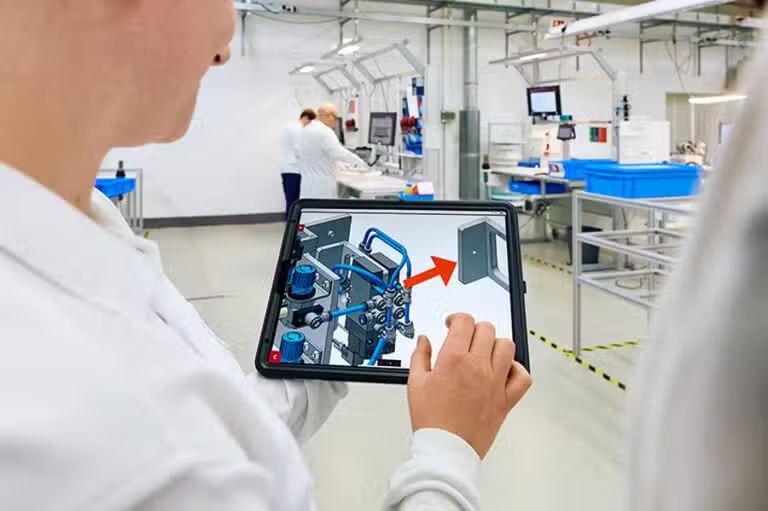
It enables the digital provision of work and inspection instructions for maintenance and servicing directly on site. Your teams have access to up-to-date information, checklists and process documentation at all times – mobile, secure and intuitive.
In this way, maintenance strategies become a lived practice: clear, transparently communicated and documented in an audit-proof manner.
The “instructor” is becoming the key tool for successfully shaping the transition to networked, efficient and sustainable maintenance.
Maintenance and servicing strategy for your systems digitally supported: the “instructor” helps!
Condition-based maintenance is much more than a technical strategy – it is a key lever for efficiency, reliability and competitiveness in modern production.
Thanks to the targeted use of sensors, data and digital tools, companies can precisely monitor the condition of their systems, detect problems at an early stage and determine the optimum time for maintenance work.
The “instructor” from tepcon is a practical tool that provides your teams with concrete support for implementation: for example, with documentation or instructions for carrying out a wide range of maintenance and repair tasks – structured, transparent and safe.
tepcon is your partner for innovative digitalization solutions in the industrial environment. Since 2002, we have been developing systems that make technological change tangible.
With the “instructor” you can increase the efficiency of your maintenance and secure sustainable competitive advantages.
Let us advise you – we will accompany you on the way to intelligent maintenance.